




Expandable vehicles and trailers
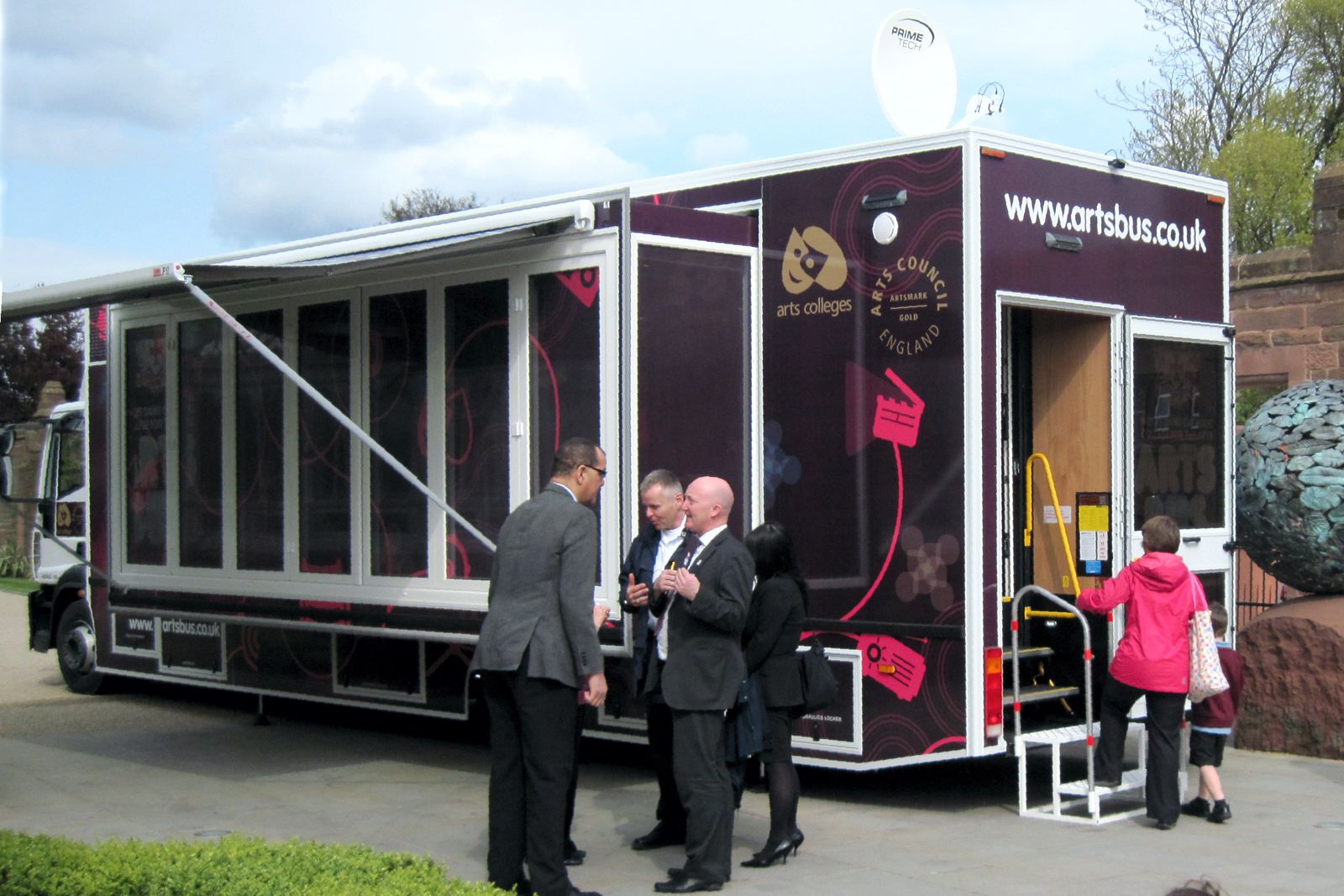
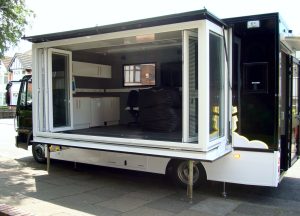 The concept of expandable vehicles and trailers may seem like a recent innovation to anyone new to mobile projects, particularly those who feel restricted by the floor space of a standard vehicle. It may, however, come as a surprise to learn that these have a rich history and are a well-established feature of many specialised vehicle designs.
Expanding vehicles trace back to the early 20th century, when sleeping cubicles were first fitted to the rear of Model T Ford runabouts. By World War II, expandable vehicles and trailers had become essential components of mobile command units and field workshops.
While the fundamental concept dates back over a century, the late 1980s marked a major shift. Specialised vehicle builders—pioneered by companies such as Club Car and Leicester Carriage Builders (now Multi Vehicle Technology Ltd)—began equipping vans, chassis cabs, tandem axle trailers, and articulated trailers with “gull-wing” extensions and slide-out “extension pods.” To create expandable exhibition, hospitality, and training trailers, even accompanying some with rooftop viewing platforms.
Types of expandable extensions
 Gull-Wing Extensions
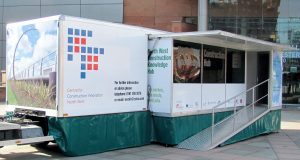
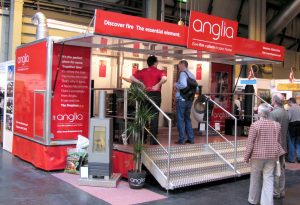
Before the late 1980s, roadshow and exhibition trailers relied heavily on manually operated gull-wing extensions. These featured hinged-up canopy roofs over hinged-down platforms to provide inviting entrances, increased floor space for hospitality or performance stages and were fitted with PVC side panels for weather protection. Early models required support poles to prevent the canopy from sagging or collapsing, along with hinged banner boards to add structural rigidity toward the centre of the canopy.
These gull-wings provided creative design opportunities with remarkable versatility in shape and size. The traditional rectangular or square layout was frequently adapted into semi-circular curves for individual style and enhanced visual appeal.
Over time, the original PVC panels were replaced by fully removable solid or glazed wall panels or folding hinged sections to speed assembly—creating fully enclosed, weatherproof extensions.
The major restriction of gull-wing vehicles is transit storage: any furniture or equipment used within the expanded area must be packed up and stored inside the main body of the vehicle during transit. This can be quite restrictive for many roadshow activities.
Slide-Out Extension Pods
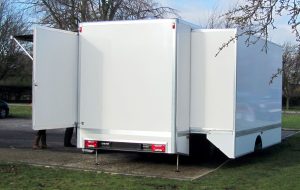
To overcome the limitations of the in-transit storage of gull-wings—particularly for mobile command centres and product demonstration vehicles—designers improved and enlarged the historic smaller slide-out pods, which at that time were used primarily on RV’s (recreational vehicles).
Operating much like a drawer (but with a roof), slide-out extensions accommodate built-in furniture, heavy equipment, interactive screens, and custom furniture to remain permanently installed inside the pod during travel.
Upper-Deck and Roof Extensions
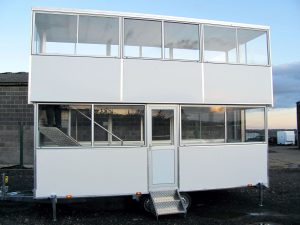
Floor space does not just expand sideways—it expands upwards. Trailer roofs have long served as viewing platforms for sporting event hospitality. Modern designs and engineering take this a step further by deploying slide-out pods even on upper levels, effectively doubling usable floor space on a multi-deck footprint. A great example being the three deck trailers used by Movico who provide trailers for major sporting events throughout Europe including the Tour de France.
How mechanics have evolved for expandable vehicles and trailers
- Manual Systems: In the early 1980s, setup required gas struts and significant physical effort to assemble gull-wings. Early slide-out pods sat on wheels or roller blocks and had to be pushed in and out manually. On larger articulated trailers, this process was labour-intensive and frequently led operators to dangerously skip key safety steps. Rising labour costs and stricter safety standards quickly pushed the industry toward mechanisation.
- Electric Motor Drives: Early lightweight slide-outs adopted small electric motors to extend and retract pods smoothly.
- Hydraulic Systems: Because electric motors struggled with larger and much heavier gull-wings, hydraulics took over. Using either manual pump levers or powered hydraulic rams, deployment became effortless.
- Telescopic Slides: Modern 21st-century designs are now making extensive use of heavy-duty telescopic sliders, enabling massive expandable extension pods to slide out easily without requiring ground supports or manual outriggers.
Benefits across different types of expandable vehicles and trailers
Current hydraulic / electric push-button systems allow full setup within minutes, drastically minimising crew workload on site whilst providing numerous benefits for the user.
- Maximised Floor Space: Increases internal floor area by 30% to over 100% without requiring a larger, harder-to-drive chassis.
- Road-Legal Transport: Retains a standard vehicle width while travelling, ensuring compliance with road regulations, access through tight streets, and easier parking.
Exhibition, information & product demonstration vehicles and trailers
- High-Impact Presentation: Creates a spacious, permanent showroom feel that attracts larger crowds and avoids a cramped appearance.
- Higher Foot-Traffic Capacity: Accommodates steady streams of visitors without causing bottlenecks near entry and exit doors.
- Dedicated Product Zones: Provides clear boundaries for interactive displays, VR stations, hospitality lounges, and private meeting rooms.
- Enhanced Visual Branding: Expanded exterior walls function as high-visibility backdrops for high-resolution graphics and signage.
Incident response vehicles
- Multi-Agency Collaboration: Provides ample workspace for joint operations (police, fire, EMS, local council) to sit together at central conference tables.
- Increased Wall Space: Expands wall area to mount large video displays, drone telemetry screens, maps, and dispatch consoles.
- Partitioned Rooms: Separates quiet tactical planning areas from high-noise radio dispatch and phone communications using physical walls, privacy curtains, or partitioned zones.
Mobile medical & healthcare vehicles
- Patient Privacy & Confidentiality: Creates fully enclosed, sound-isolated consultation and examination rooms.
- Full-Scale Clinical Equipment: Fits large medical gear (dental chairs, X-ray equipment, phlebotomy bays, mammography suites) while maintaining required operational clearance.
- Improved Workflow & Accessibility: Allows separate waiting areas, reception desks, and triage bays to keep patient flow organised and hygienic.
- ADA & Wheelchair Compatibility: Extra floor space accommodates wider interior ramps, wheelchair turnarounds, and accessible restroom facilities.
Commercial experiential units & classrooms
- Immersive Retail: Large, open-plan spaces support full retail environments, product showrooms, and VIP hospitality suites.
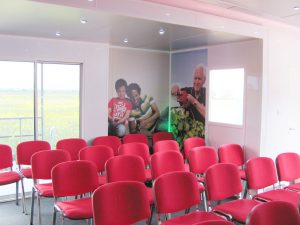
- Mobile Training: Generates large open seating areas suitable for theatre-style training arrangements and interactive classrooms.
Can there be multiple extensions on expandable vehicles and trailers?
Yes. Multiple extensions can easily be installed on a single vehicle. A recent example is “The Experience Factory” built by Multi Vehicle Technology for Fath Components Ltd. Despite being built on a compact 3,500 kg chassis cab, it features three gull-wing extensions, transforming the vehicle into a massive, multi-zone product demonstration hub.
Combining gull-wing extensions with slide-out pods is also common, especially for exhibition trailers to gain the features and benefits of both in a single vehicle conversion.
Technical design considerations
- Chassis Twist: Vehicles naturally flex over uneven terrain and during cornering. Because slide-out mechanisms rely on precise alignment, maintaining structural integrity of the vehicle body is important.
- Reduced Payload: Extension components—including frameworks, panels, slide tracks, hydraulic actuators, gas struts, and reinforced hinges—add weight. While keeping the vehicle under its Maximum Authorised Mass (MAM) ensures road legality, it reduces the overall carrying capacity (payload).
- Clearance Requirements: It is vital to understand where the vehicle will be deployed. Installing the largest possible extensions is counterproductive if the vehicle is to operate in restricted spaces, such as town centres and shopping precincts, where there is not enough physical clearance to extend the pods.
Let Multi Vehicle Technology build your expandable vehicles and trailers
At MVTech, we believe specialised vehicles should be dependable, beautifully finished, and free from unnecessary complexity. We design and manufacture bespoke vehicle conversions for clients who value exceptional build quality and striking aesthetics, delivering a strong return on investment.
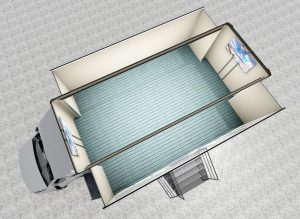
Our in-house team of experienced designers and engineers manages every project—from initial 3D visualisation through to final delivery. Whether you need an emergency command vehicle, a mobile showroom, or a specialised training unit, we engineer solutions built to perform reliably year after year.
Ready to start your next vehicle build?
- Call Us: 0116 326 0989
- Email Us: sales@multivehicletechnology.co.uk
Contact us today to discuss your project and let us bring your vision to life.
